Thursday, September 22, 2011

Seoul Cool - September, Travel + Leisure


Things we loved in Seoul: The street scene - very nyc, the coffee shops (millions of them), the indie designers, Mapo-Gu and Garosugil, walking around the hills of Samcheong Dong, vegetarian dinner at Baru, Miss Park, the size (one of the largest five cities in the world, surprisingly), the couple who started Mogool Millinery, Soju....and, of course, all the lovely people we met and worked with!
A lot more than a little bit of soul in Seoul.

Sunday, September 18, 2011

Friday, September 16, 2011

Monday, August 29, 2011

Leviathan

Earlier this summer I made a quick visit to see my dear friends Raphaëlle and Xabi in Paris. Raphaëlle shared this grand exhibition, Monumenta, "Leviathan" by Anish Kapoor. The video does not do justice to the delightful experience of being plankton for a day.


A quick plug, Xabi has a new book out this month, here (en français).

Wednesday, June 22, 2011

Malaysia's foodie tour - Budget Travel's May issue


This one blew right by us! We shot this feature for Budget Travel in the May issue. It's a wonderful journey up the Malay peninsula from Melaka (Malacca) to Kuala Lumpur up to Penang.

DONALD & LILIE'S: This wonderful family of three takes Nonya cuisine to a whole new level. They operate a small unassuming cafe out of the back of their Peranakan home on the main drag of Melaka's historic district. It was after tasting their Laksa that James decided it to be his favorite Southeast Asian dish -- followed closely by Roti canai! This shoot, for us, was an opportunity to try all the different sorts of Laksa they make in Malaysia -- Assam, Nonya, etc.


Because Melaka is so small it feels very classic. Some of the best places in town are tucked into 100+ year-old shophouses, and the vibe is lively on weekends as people pour in from nearby Singapore for a taste. Here, the Peranakan tradition seems very strong, at least at the tourist level.

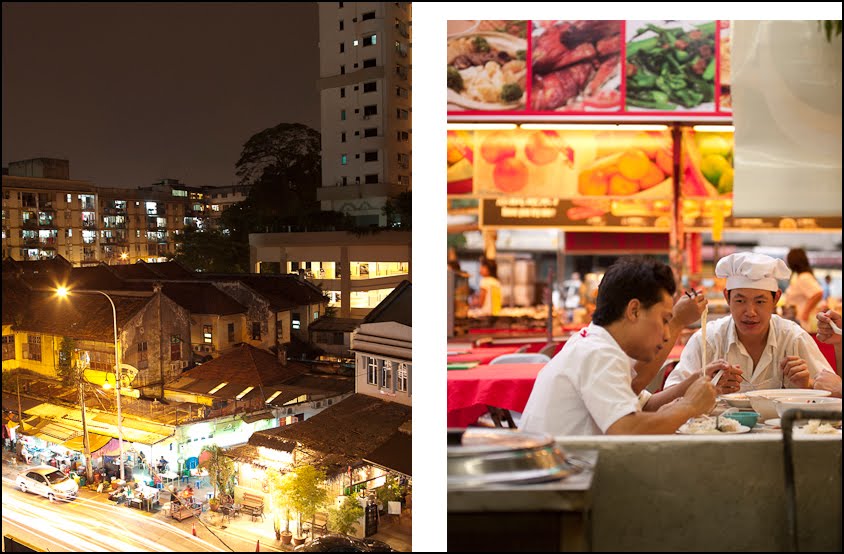
KUALA LUMPUR: The contrast between little historic Melaka and bustling modern Kuala Lumpur is stark. We were in the Jalan Alor area, where the street food is gritty and hot! The vibe seems like a blur between classic Malay culture and architecture mixed with a street vibe that I imagine might resemble New York in the 1970's. We introduced ourselves to barbecue stingray, which tasted like something between crab meat and moist grilled cod, and loving the tangy and spicy rub.
The Sunday morning scene at Yut Kee, where the one-day-a-week roast pork extravaganza creates a line all day long! (right)

We hear rumors that this old and cherished establishment might be pushed out by city development in the area. We sincerely hope not!

Next stop, OLD-TOWN PENANG: We've walked the streets within this historic, unesco-heritage town several times now! It's old, it's hot, rough-and-tumble, and completely charming. In Georgetown, you can find old popiah sheet-makers (below, right) - think pizza tossers mixed with crepe street-venders.

Hotels like the Straights Collection that let you roam through vintage architecture and straits-style furnishings. It's no-doubt our favorite place to stay when in Malaysia (aside from its other location on the island of Langkawi!)

Wednesday, March 30, 2011

Big River

Before we introduce this new work to you, I'd like to take a moment to remember my Aunt Lorene Joslin, who passed away peacefully in Springfield, Missouri this past weekend. A minister to the deaf and a woman of great faith, who spoke with her hands and her heart, she will be missed by our families. I'd like to dedicate the photograph you see here, made last October in Laos, to her memory. It's one of my very favorites, and I hope she'll like it.


One of our adventures last fall was a three day trip up the mighty Mekong from the Thai border to Luang Prabang last October with the classy boat outfitters Luang Say. We shot the story for Budget Travel's spring "Dream Trips" issue.

James is fond of telling people that two things are true of Laos, first, that we would never in a million years have thought we'd get the opportunity to go there twice, each October we've been in Asia--it's just so far away feeling. Second, the town of Luang Prabang is the rare place where you can close your eyes and know right where you are: the smell of the river and the spicy food, the sounds of chanting, bells, and bicycles, the soft mountain air on your face. We'd gladly spend a lifetime sitting in front of Le Banneton, munching on croissants and coffee, getting to know the young monks of Wat Saen, and smiling back at the golden Buddha across the road.
Our boat stopped over at a small fishing village near Pakbeng. The Khamu (or Khmu), one of the largest ethnic groups in Laos (a place of many ethnicities), live communally in small villages along the river, trading products, fish and rice in the market in Luang Prabang.

It's become an integral part of our photographic practice to give back to the people we photograph by making polaroids after the shooting's done. So without further ado: a video of our happy afternoon among the Khamu.


Wednesday, February 23, 2011

Blissed out Bali! On Newstands


In December we made a second trip to Mambal, near Ubud, to photograph a new treatment center for Destinasian, a luxury travel magazine based on this side of the world.
We lit the model Indah (left) with a strobe in a bathtub to her left, and photographed her from a neighboring treatment hut.

The river-side retreat, called Fivelements, provides the healing arts Bali has become known for, and adds an exceptional raw-vegan restaurant, villas with groovy lights, and family-style attention to a long list of spiritual and physical interventions, performed by these guys: Pak Dewa re-aligned my Chakras one afternoon, and Wayan cured a headache with a brief massage, and everyone there made us feel right at home.


Monday, January 24, 2011

Recipe Binder, now available

If you had the pleasure of eating chez James on Henry Street, you'll know I have kept up an extensive collection of recipes to keep him curious and cooking! That scrapbook, a record of what we made there for you in those good years, fell apart. So in order to preserve the memories these recipes contain, I've scanned every page and had them rebound on Blurb.


You might have seen advance copies at Katie's or Gram's or Mom's house at Christmas time. You can order your own if you like! There's several ways to make a Chocolate Chip Cookie inside, and James's vegetarian chilli, and some recipes you've shared with us. Don't hesitate to let us know your favorites!


Wednesday, January 5, 2011

Singapore feature: now on newsstands


We've got a feature in January's Travel + Leisure (US edition) on our town. Apologies to our local friends for the note of surprise the author adopts when finding Singapore fun, passionate, cool.

For this story, since we are "on the ground" in the city, we contributed photographs of some of our favorite places to round out the coverage. Among these are the handsome young men of White Canvas Gallery (see the opening spread) and Sungei Road Laksa, a "die-die must try" bowl of deliciousness that costs $4 (below).


Our thanks to T+L for giving us such a fine excuse to spend some serious time shooting our own backyard.


Friday, December 24, 2010

Happy Holidays!


Wishing you happy holidays
& a year full of blessings.

Off to Bali!

Love,
Jessie and James

Tuesday, November 30, 2010

Conference Paper on John Thomson


The Humanities Initiative at New York University invited me to present a paper on my photographic research and practice as part of their "Ambience in the Humanities" conference the weekend before Thanksgiving. The discussion, entitled "Cinematic Vistas," posed these questions:

At what point do images tell us we are out of place? What landscapes of imagination open up when we enter new imagistic territories? How do unknown and unexpected masses of ambient imagery affect the making of pictures? How, then, does ambience frame the vision of photographers and movie-makers before they themselves attempt to bring the world into frame? What happens when sudden shifts in culture, place, and external stimuli make these ways of seeing apparent? Where are our imaginations located?
For my presentation, I chose to tackle these questions in two parts: first, by introducing a 19th century travel photographer and essayist I am currently researching, and second, by considering about how our photographic practice has changed since we moved to Singapore 15 months ago. For both parts of my presentation, I chose to focus on the subjects of the photographs, as residents of these new "imagistic territories."

You can click through the presentation here:


Excerpts from the script of my talk, from Part 1:

Scottish photographer John Thomson's career has been celebrated by a series of “firsts:” photo-historians claim that he published “the first book ever devoted exclusively to street photography,” he created the first photographic documentary, he was the "first photographer to have a whole society as his subject,” his four volume book on China is considered “a classic of sociological photography and reformist sympathy,” and an “innovative use of photomechanical technology.” On the other hand, Susan Sontag scorned Thomson's later work in London, calling him a class tourist, and "Street Life in London" as “perhaps the earliest model of the sustained look downward.” Likewise, in Nancy Armstrong’s Fiction in the Age of Photography, Thomson’s photographs serve to demonstrate how the picturesque aesthetic informed slum photography, which in turn, she argues, distances the subject from the possibility of reform and rendered him or her into an object of fascination for Thomson’s middle class public.


These scholars are concerned with the problematic appropriation of the photographic subject for use and observation, a disquiet heightened by the very fact of Thomson’s status in this important strain of photographic use, the documentary.


That said, it is time to restore agency to the subjects of the photographs, those that people the "ambient" landscapes captured in the document, co-create the photograph, and who are engaged in the creation of the image. Subjects resist being captured in a frame in a way that contemporary criticism does not always account for. Prevailing criticism brings to light sets of ideas that trace power and influence from photographer to audience, but do not adequately address the relationship between subject, photographer, and audience in the moment of photographing. This paper will revolve around these three nodes of exchange -- photographer, subject, and audience -- but I hope ultimately to leave you with the subject, the men and women who are in focus in this frame and every frame, though somehow, of whom we can have only glimpses.

From the discussion on the King of Siam:

The photograph and the essay share the same author; nonetheless, interpretative details about the subject resist and append the information provided by the essay text. Photographs radiate meaning in variegated patterns, and our responsibility is to chart the vast differences in what we see, inside the photographic frame, and what we assume, or read about, occurring beyond the frame. The photographic detail exhorts against the division between the indexical moment of photographing and the material photograph. This contingent detail, the King's uniform, is a flaw or an opportunity that, to rephrase Benjamin, will never consent to be wholly absorbed in text.
And from part two, on Morgan & Owens in Asia:

In the first photograph, we have just "parachuted" into this Khamu girl's life - our boat landing at the beach near her village in Northern Laos only moments before. To me this photograph is unsatisfactory, for its prevalent emotion is trespass. This image is brought to you by Dolce and Gabbana.


In the video, the children pose for a group shot. The punctum in this sequence, for me, is the couple looking on -- tourists -- and our future audience.


In our move to photograph Asia, we have found a new use for an old technology, Polaroid transcends language barriers, invites collaboration. When people see what they look like, what sort of image we intend, they adjust, they direct, and they get something in return.


The photographs that bring us the most joy, I believe, were those made in collaboration with the subjects. They are records of an encounter, the willingness to engage strangers, an hour spent together. I made this photograph after we had gotten to know each other, and we had photographed several children in her village. She has changed her skirt from her school uniform to a favorite, and posed herself at home with a friend. She doesn't know why we are there, or what audience these photographs will have, but like the King of Siam, she knows how she wants to look.


Thanks for watching!

Jessie

Friday, November 12, 2010

ONE Photography Convention in ION Gallery

Early in the summer, we were invited to produce "personal" images around the theme of ONE, along with 28 other photographers based here in Singapore. Our result was five images made on ONE street in Georgetown, Penang ONE hour in the morning. The images will follow, but first: a video of the show, for those of you who can't get here in person.

Friday, November 5, 2010

Shanghai mornings

In Fuxing Park in Shanghai, early in the morning, the older folks get together to do Tai Chi and play badminton, and DANCE! What a way to start the day!


We took the opportunity to make portraits of some seriously happy people, and burned through a packet of Polaroid in exchange. It's always fun to give something back, especially when you don't speak the language!


Wednesday, November 3, 2010

T+L launches ipad version featuring our Shanghai story

We haven't seen the final product, but from this video it looks pretty cool. If you have an ipad, check it out and look for an extended version of our November Shanghai feature!

PS. Our good friend Cedric Angeles did the photography and video for the New Orleans video.